Sunday, March 13, 2011

Rockport Beach Park

Rockport, Texas has many great birding areas and one always cited is the Beach Park.  It’s  long sandy beach with lots of grassy picnic areas.  It also is the protected nesting site of hundreds of Black Skimmers -- that graceful bird known for flying low over the water, lower mandible skimming for small fish and other goodies. 
Black Skimmers on the go
I’ve not been to the park since dogs are not allowed and every time I’m in Rockport, I have Penny with me.  Today, I brought my bike and left the dog in the truck and pedaled in for a little birding.  Hundreds of Laughing Gulls filled the air with their raucous calls as I passed by and up ahead, I saw a gaggle of Black Skimmers circling and landing.  There’s a nice observation area near the roped-off nesting site and I took a bunch of photos of the birds whirling by.  It was quite a spectacle.

They’ll start nesting next month and I’m sure it is quite a sight to see the chicks and their parents up close.  Perhaps next year we’ll stick around a little later.

Laughing Gulls
I saw a Long-Billed Curlew, a Pied-Bill Grebe, a Willet, a bunch of American Avocets, Herring/Laughing/Ringed-Billed Gulls, and a number of other birds during the short bike ride.  It’s a place I will get back to another time.

The Laughing Gulls, now in their plumage, just are characters.  Here’s a lineup from the walkway to the observation platform.  They laugh -- and tend to make you chuckle as you see and hear them.  

Sunday, March 6, 2011

Yellow-faced Grassquit: Yes!

Yellow-faced Grassquit
A rare tropical bird, a Yellow-faced Grassquit, showed up at Goose Island State Park about a week after we left in January. For a month now, I have read posts of sightings of him - hundreds of birders have come to see him and he's been very cooperative.

I thought that it would be a one-time chance to see him so we decided to return to the park for a week. It's also a place we love and a good spot to celebrate my birthday. So we drove the short distance down from Goliad this morning.

While driving in to look at the few vacant sites, we drove by the spot where he's been seen. Probably 25 birders were there, binoculars up and looking - and it was hard not to just stop the truck and trailer and join in.

We signed for a nice spot, got unhitched and set up and it was time to exercise the dog - which I did by bike. We rode past the spot but the few folks there had seen nothing since the morning. So, figuring we had all week, I had lunch and a little rest.

Mary suggested I go back and so I did. There were some women down from Houston and a guy who flew in for the weekend from Oregon. We waited and watched a few sparrows. The women decided to leave and I was about to when the Oregon guy - who is quite skilled as a birder - saw it fly into the brush and yelled "bird." That got the gals hustling back and sure enough, the little rascal was just perched in the shade. You could see him but when the Oregonian got his scope, the bird was spectacular.

The Grassquit breeds from central Mexico to northern Ecuador and northwestern Venezuela, and also on the Greater Antilles and nearby islands (e.g. the Cayman Islands, and Jamaica). It is not a migratory bird but moves about outside the breeding season. It's neat to think how far from home he is - and what an extremely rare sighting for the U.S.  Glad we came back here.

I'm sure I'll get to see the guy a few times more and get some photos. The one above is from the web - but is just like the guy I saw this afternoon.

Friday, March 4, 2011

Rio Grande Turkeys

As I was sitting behind the Airstream reading on our last evening in South Llano River State Park, the dog stirred and became interested in something behind me.  It was a “parade” of about 25 Rio Grande turkeys strolling down the park road enroute to their roosting spots along the river.  They are pretty birds -- a little smaller than our eastern turkeys but seemingly longer and taller.  It is pale and copper-colored having tail feathers and tail/rump coverts (short feathers located at the base of the tail) tipped with a yellowish buff.

South Llano River SP is home to one of the most significant Rio Grande turkey roosts in Central Texas.  About 800 turkeys roost every year at the park and their grounds are marked off until April.

The Rio Grande wild turkey is native to the semi-arid areas of the southern Great Plains states: Texas, Oklahoma, Kansas and Northeastern Mexico. It received its common name from the Rio Grande River, which is the water supply bordering the brushy scrub, arid country of some of its prime range in western Texas and northeastern Mexico. This race of turkeys generally occurs in areas having 16 to 32 inches of rainfall.

This subspecies was first described by George B. Sennett in 1879 who said it was intermediate in appearance between the eastern and western subspecies, hence its scientific name, Meleagris Gallapavo Intermedia.
Rio Grande Turkey strutting its stuff
Originally existing in the millions, this turkey had depleted to extremely low numbers by 1920. Formal programs involving trapping and transplanting were initiated in the 1930's and today it exists over much of its ancestral range. Texas has the most Rio Grandes with a population estimated at over 600,000 birds.

One of the neat things camping at South Llano River is to hear the turkeys call to one another in the early evening -- and then again in the morning.  And then to see them parade from their roosts, sometimes displaying as in the photo I took the other day. 

Please visit our Airstreaming blog

Wednesday, March 2, 2011

My New Favorite Bird

As we have progressed through the South and Southwest with our Airstream, I have made favorites of several species of birds I've seen.  The last one was the Cactus Wren.  I never saw one (knowingly) last year and once I spotted one in Falcon State Park, I knew what size they were, where to look, and what to listen for.  And then, I ran into them all the time.  In fact, one was singing to us as we packed to leave our last campground.

Towhees have been birds I've been looking for.  I found one, then dozens, of Canyon Towhees at Davis Mountains State Park.  They are a bit bland but neat birds.

Spotted Towhee
But the Spotted Towhee has me enamored these days.  I saw my first one at a feeder here at South Llano River State Park and now see them each day.  They are beautiful and there agressive scratching the ground for food is fun to watch.  They hop and attack their food -- feathers puff, dirt flies.  They've got a lot of spunk.

So, until I find a new favorite, the pretty Spotted Towhees are my pick of the week.

Saturday, February 26, 2011

Water

One of the tricks that western birders seem to know is that if you can find water, you can usually find birds.  That’s been the case for me the last week or so.  At Big Bend, we stopped at an old ranch site where a dilapidated windmill, clanking away, delivered a little water in drips but attracted some interesting birds including a Green-tailed Towhee.

Here at Davis Mountain State Park, where I have seen a number of life birds including the Montezuma Quail, they have water at all feeding stations.  I put out a water drip at our campsite and regularly attract Canyon Towhees, Black-crested Titmice, White-winged Doves, Cactus Wrens, and a host of different types of sparrows.

Not far from here is a dry creek which has a little “seep” -- a wet spot under some clumps of bushes.  It’s about a quarter-mile hike up the creek bed and as you get there, the birds all fly off but ten minutes later, you can see dozens of birds.  I was particularly looking for the Black-chinned Sparrow which I saw.  (It’s a little drab this time of year -- mostly grey -- but it’s Black-throated cousin -- also there -- is starting to show breeding plumage.)  Here’s my list from yesterday morning for about 30 minutes of watching and photographing:

Black-chinned Sparrow
Black-throated Sparrow
White-winged Dove
Black-crested Titmouse
Ruby-crowned Kinglet
Pyrrhuloxia
Cactus Wren
Chipping Sparrow
Western Scrub-Jay
Canyon Towhee
Phainopepla
Lark Sparrow
Vesper Sparrow
Northern Mockingbird
Rufous-crowned Sparrow

Here are a few photos I took at the “seep:”
A Black-chinned Sparrow in non-breeding plumage

I love the Black-crested Titmouse

A pair of Cactus Wrens

Friday, February 25, 2011

Life Birds on this trip

To date, I have added 35 birds to my list and missed a number of others.  All except one were in Texas.  I haven't gone out of the way for any rarities but just logged stuff I've seen.  It's an interesting way to recall the birding along the way -- eBird does it electronically.

Altimira Oriole

Monday, February 21, 2011

Desert Birds

Getting away from the coast or big bodies of water like Lake Falcon and Lake Amistad, makes the birding more challenging - or at least until migration starts in a month or two.  However, I’m still picking up some nice birds for my life list: today I saw a Bell’s Vireo outside the Panther Junction Visitor Center.  Saw a wonderful Rock Wren working the cliffs near Amistad the day before.

We were inundated with Black-throated Sparrows and Lark Buntings at our last campsite after spreading some seed out the day before.  A lot of White-crowned Sparrows also showed up but were a bit more wary.  Then, as we had supper one evening at the picnic table, a Sage Thrasher cranked up its song from a nearby bush.

I’m sure I saw some Zone-tailed hawks with a bunch of Turkey Vultures yesterday but I was doing 70 hauling a trailer and thought it improper to grab the binoculars.  Likewise, a bird with a long curved bill flew up alongside us as we approached Big Bend.  Have no idea what it was.

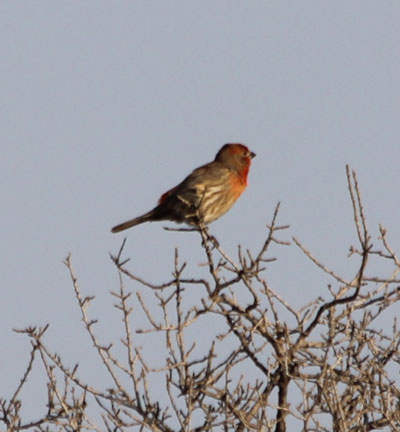
The House Finch was interesting:  I don’t know the bird well and thought it was some bunting.  The male is just spectacular, as is the singing. 
House Finch

Big Bend has hundreds of birds on the list although many are migration spottings or later in the year.  I’ve got a few on my list though -- so Penny and I will be out and about scanning.  I guess I can’t count stuff across the river - that’s Mexico.